
/
When I went to my studio two years ago, I found a pot in a second-hand shop, which caught my attention.
The pot is made of white porcelain, glazed with a transparent glaze. Two patterns are painted on the surface: one on each side. They represent a couple. Their clothes make me think that they come from the nobility, from the time before the French Revolution. The colour palette makes me think that the scene is set in Europe. In the pattern, the man is sitting above the woman, talking. She is listening to him, she is wearing a pink dress. The background is trees and nature, painted in pink, purple, blue and green. On the right side of the woman, there is also a small tree with red leaves, which shows me that it is towards the end of summer. Autumn is coming.
Under the pot is a stamp that says Geflé porcelain industry and a date: 1945. I decide to buy the object.
I have found this kind of pattern many times in second-hand shops on different kinds of objects from different countries, with or without a stamp.
Why did I bought this particular pot? Who is the painted couple? Who bought the pot first? What did the colours of the pattern mean in the past and what do they mean now?
Like a detective, I traced the pattern through Europe, from Sweden to France and to Austria. I’ve asked in museums but haven’t found it. I’ve also asked my family and friends about how common the pattern is. I have read books, I have watched films, etc.
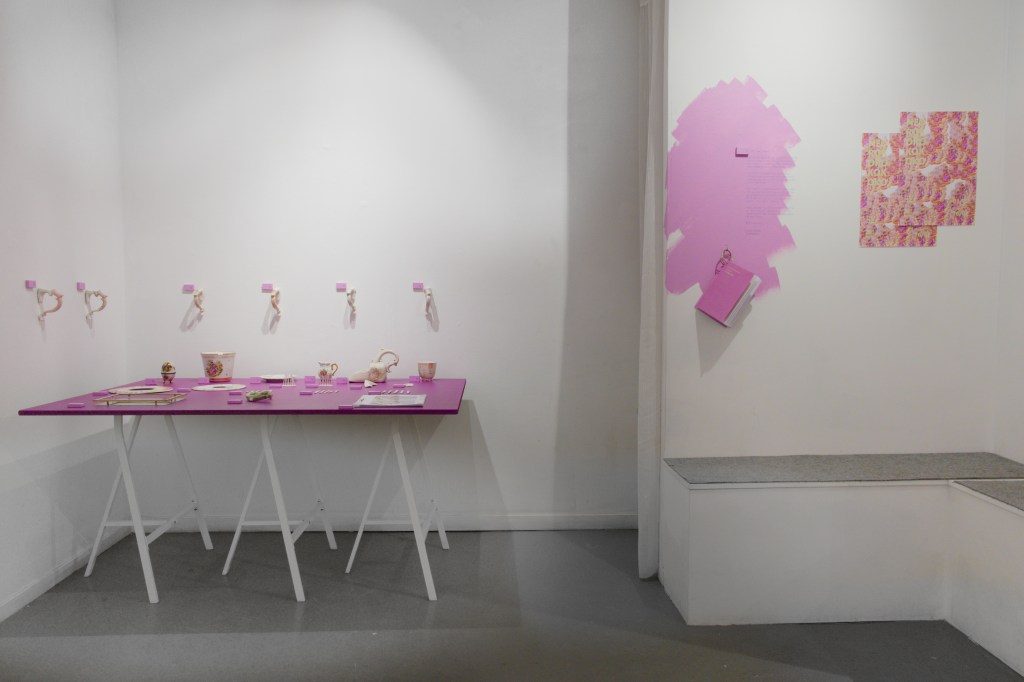
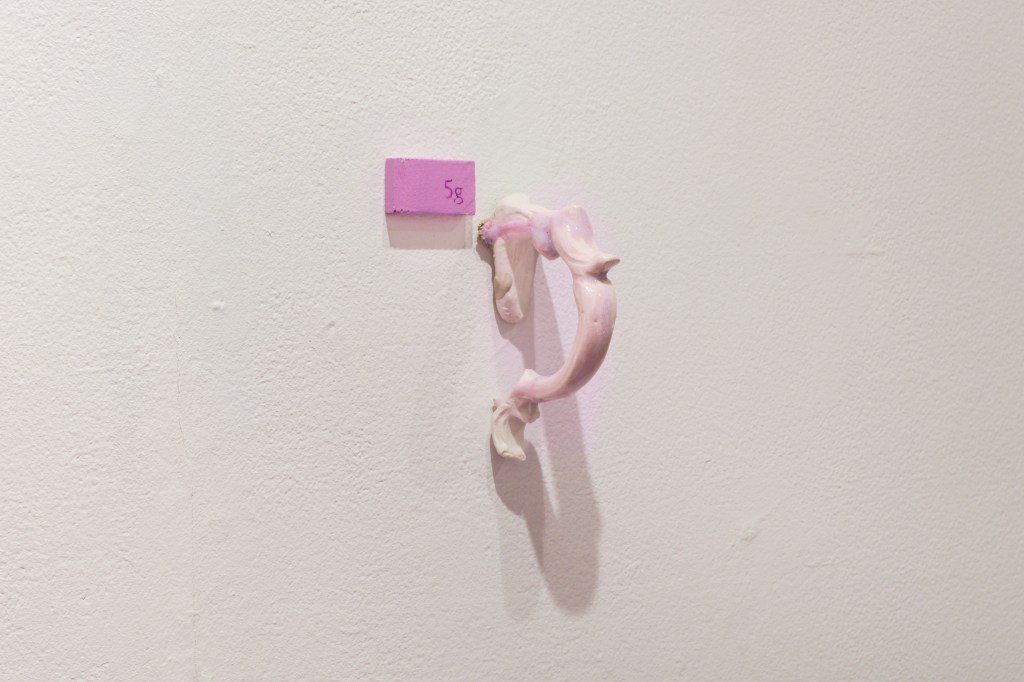
Inspired by the questions I was asked, I have started experimenting with ceramics in my studio, testing the colours, the pattern, the painting, etc. Through text and ceramics, I share with you what I have discovered along the way, my questions and the importance of the pattern today. I hope that together we can create a new meaning around a neo-rococo pattern.
Publications:
Anne-Marie Dehon, Neo-Rokokokokoko…: guideboken, 2024.
« Love, Nature and Porcelain: Invitation To a Cruise Along a Neo-Rococo Motif », In A. Dehon, H. Kjellberg, B. Lee, E. Lindeborg, D. Ramos Obregón, D. Ronco, In the Making: the crack that lets de light shine in, Konstfack edition, 2024.
A project supported by: Estrid-Ericsons Foundation, Helge Ax:son Johnsons Foundation.
 annemariedehon.art